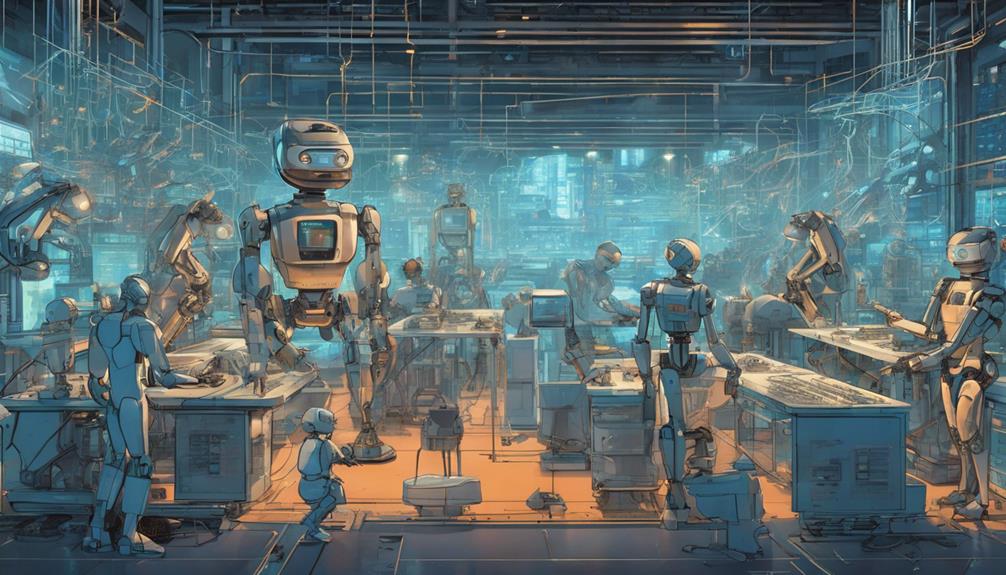
How Robotics Is Shaping the Future of Work
Robots are reshaping the modern workforce, shifting traditional job roles to focus on creativity, critical thinking, and human-robot collaboration. Whilst automation may displace certain jobs, it will also generate new opportunities in fields like AI ethics and robotics engineering. Industry-specific strategies will open up productivity gains and create new opportunities. As robots enhance human capabilities, reducing worker fatigue and improving job satisfaction, the need for skills like data analysis, emotional intelligence, and problem-solving will increase. With the future of work swiftly evolving, grasping the intricacies of this transformation is vital for tapping into its full potential and mitigating its risks.
Robots in the Workplace
How will the increasing presence of robots in the workplace alter the dynamics of human collaboration and redefine traditional job roles? As robots become more widespread in various industries, they will inevitably transform the way humans work together and interact with machines. Human-robot collaboration will become the new norm, where humans will work alongside robots to accomplish tasks that require precision, speed, and efficiency.
In this new era of human-robot collaboration, traditional job roles will undergo a significant shift. Humans will focus on tasks that require creativity, empathy, and critical thinking, whereas robots will take over repetitive, hazardous, or labor-intensive tasks. This shift will not just improve workplace safety but also free up human capital to focus on higher-value tasks. Robots will be designed to perform tasks that are too risky or challenging for humans, reducing the risk of workplace accidents and injuries.
Effective human-robot collaboration will rely on seamless communication and integration between humans and machines. This will necessitate the development of advanced interfaces, sensors, and algorithms that enable robots to understand human intentions and behaviors. As robots become more integrated into the workforce, organizations will need to invest in training programs that equip humans with the skills to work effectively alongside robots. By embracing this new era of human-robot collaboration, organizations can access new levels of productivity, efficiency, and innovation, ultimately propelling business success.
Job Displacement and Creation
As robotics continues to transform the workforce, a pressing concern arises: the dual impact of automation on job displacement and creation. Firstly, robots are likely to displace certain jobs, particularly those involving repetitive tasks, conversely, new job opportunities are emerging that require human skills to design, maintain, and operate these machines. This double-edged effect of automation necessitates a nuanced perspective of its implications on the labor market.
Automation's Double Edge
One of the most urgent concerns revolving around automation is its dual effect on the workforce, displacing specific jobs at the same time as generating new ones that demand different skill sets. This two-sided aspect of automation requires a nuanced strategy for its implementation, one that gives importance to workforce adaptability and ethical automation practices. As machines take on routine and repetitive tasks, workers must be equipped with the skills to shift into emerging roles that utilize human creativity, empathy, and problem-solving abilities.
Ethical automation involves recognizing the repercussions of technological advancements on the workforce and taking proactive measures to lessen negative impacts. This includes investing in retraining and upskilling programs, in addition to nurturing a culture of lifelong learning that enables workers to adjust to changing job requirements. By embracing a comprehensive approach to automation, organizations can leverage its benefits while reducing the risks, ultimately shaping a future of work that is more efficient, productive, and fair for all.
New Jobs Emerging
The emergence of new job opportunities is a direct result of automation displacing traditional roles, with various sectors already witnessing the creation of innovative positions that did not exist a decade ago. As technological advancements continue to transform the job market, professionals must adapt by investing in skill variety to remain relevant. This shift has also led to the rise of remote chances, enabling workers to contribute from anywhere in the world.
New job titles such as AI Ethicist, Robotics Engineer, and Data Analyst have surfaced, requiring specialized skills to navigate the intricacies of automation. The job market is evolving, and professionals must be proactive in acquiring the skills necessary to thrive in this new terrain. As automation continues to enhance human capabilities, it is vital to recognize the potential for job creation and upskilling. By embracing this change, we can explore new opportunities and propel growth in various industries.
Industry-Specific Impact
Across various sectors, robotics is transforming the nature of work, yielding significant productivity gains and cost savings in industries such as manufacturing, logistics, and healthcare. This paradigm shift is particularly pronounced in healthcare, where robotics is revolutionizing patient care and outcomes. Healthcare applications of robotics include advanced surgical systems, robotic-assisted rehabilitation, and autonomous patient transportation. These innovations not only improve accuracy and efficiency but also enrich the overall patient experience.
In agriculture, robotics is driving advancements in precision farming, crop monitoring, and autonomous harvesting. Robotics-enabled farming systems optimize crop yields, reduce waste, and minimize the environmental impact of farming practices. Furthermore, autonomous farming equipment enables farmers to work more efficiently, reducing labor costs and improving productivity. The integration of robotics in agriculture also allows for real-time monitoring of soil conditions, weather patterns, and crop health, enabling data-driven decision-making and more effective resource allocation.
As robotics continues to permeate various industries, it is vital to recognize the far-reaching implications of this transformation. By gaining insight into the industry-specific impact of robotics, businesses and policymakers can develop strategies to utilize its potential, drive growth, and create new opportunities for workers. By embracing this technological shift, we can unleash unprecedented productivity gains, improve lives, and shape a brighter future for generations to come. Moreover, it is crucial to understand how technology shapes lasting impact on workforce dynamics and the economy as a whole. As automation and robotics revolutionize traditional roles, there will be an essential need for reskilling and upskilling programs to equip workers with the necessary tools to thrive in an evolving landscape. This proactive approach will ensure a smoother transition, allowing societies to harness the full potential of robotics while minimizing disruptions and fostering inclusive growth.
The Rise of Remote Work
As robotics transforms the modern workplace, the traditional boundaries of physical presence are dissipating, giving rise to virtual teams that can collaborate seamlessly across distances. This shift has sparked the evolution of remote workspaces, where employees can work efficiently and effectively from anywhere. By utilizing the potential of remote work, organizations can tap into a global talent pool, increase productivity, and reduce operational costs.
Virtual Teams Assemble
Remote work setups, driven by advancements in communication and collaboration technologies, are increasingly enabling virtual teams to come together and thrive in the modern workplace. This shift is fueled by the need for greater flexibility, autonomy, and efficiency. As a result, organizations are utilizing collaborative robots and virtual collaboration tools to facilitate smooth interaction among team members.
Virtual teams can now access a variety of digital platforms and tools that empower them to work together in real-time, regardless of geographical location. This has opened up new opportunities for global talent acquisition, as companies can now tap into a wider pool of skilled professionals. Furthermore, virtual collaboration has also resulted in increased productivity, reduced costs, and improved work-life balance.
In this new era of remote work, organizations must prioritize effective virtual collaboration strategies to guarantee the success of their virtual teams. This includes investing in advanced communication tools, establishing clear goals and objectives, and nurturing a culture of trust and transparency. By doing so, companies can unleash the full potential of their virtual teams and stay ahead in today's fast-paced, competitive business environment.
Remote Workspaces Evolve
Workspaces are undergoing a significant transformation, driven by the accelerating adoption of remote work arrangements that are redefining the very notion of an office. With the rise of digital nomads, remote teamwork has become the new norm, and traditional office spaces are giving way to virtual collaboration platforms. Robotic assistance is also playing a vital role in facilitating seamless communication and workflow management in these remote workspaces.
As a result, employees can now work from anywhere, at any time, and still remain connected with their colleagues and clients. This shift has not just increased productivity and flexibility but has also enabled businesses to tap into a global talent pool, unrestricted by geographical constraints. The future of work is unquestionably remote, and robotics is at the forefront of this revolution, empowering remote workers with the tools and assistance they need to thrive in this new era of virtual collaboration. As remote workspaces continue to evolve, one thing is clear – the traditional office is a relic of the past, and the future belongs to the digital nomads.
Augmenting Human Capabilities
Human-robot collaboration is revolutionizing the workforce by amplifying human capabilities, enabling individuals to accomplish tasks with greater speed, accuracy, and efficiency. This synergy between humans and robots is transforming the way we work, allowing us to focus on high-value tasks that require creativity, problem-solving, and critical thinking. By augmenting human capabilities, robotics is enhancing productivity and improving efficiency in various industries.
In manufacturing, robots are assisting human workers in assembly lines, enabling them to work together seamlessly and increasing overall production output. In healthcare, robots are helping medical professionals with tasks such as surgery, rehabilitation, and patient care, leading to improved patient outcomes and reduced recovery times. In logistics, robots are streamlining warehouse operations, enabling faster and more accurate order fulfillment.
The benefits of human-robot collaboration extend beyond productivity and efficiency gains. By taking over repetitive and mundane tasks, robots are reducing worker fatigue, improving job satisfaction, and decreasing the risk of workplace injuries. As robots continue to evolve and become more sophisticated, we can expect to see even more innovative applications of human-robot collaboration in the future. In the end, the augmentation of human capabilities through robotics will lead to a more efficient, effective, and empowered workforce.
New Job Categories Emerging
As robotics continues to reshape the workforce, novel job categories are emerging that require unique skill sets and expertise to design, develop, and maintain these advanced technologies. The increasing demand for robotics and automation is driving the creation of new occupations that didn't exist a decade ago. Robotics engineers, AI ethicists, and machine learning specialists are just a few examples of the emerging job categories that require future skills such as programming, data analysis, and critical thinking.
These new job categories are transforming the workforce and redefining the way we approach tech integration. As robots and machines become more prevalent in the workplace, the need for professionals who can seamlessly integrate technology into existing systems is becoming increasingly important. From robotics technicians who install and maintain robotic systems to data scientists who analyze and interpret data generated by these systems, the opportunities are vast and varied.
The rise of robotics is facilitating the development of new industries and business models. For instance, the growth of autonomous vehicles is giving birth to new companies that specialize in AI-powered transportation solutions. Similarly, the increasing use of robots in healthcare is leading to the creation of new startups that focus on robotic-assisted surgery and patient care. As robotics continues to shape the future of work, one thing is clear: the job market will be characterized by unprecedented opportunities for those who possess the right skills and expertise.
Skills Shift for Humans
With the increasing presence of robots in the workforce, a significant skills shift is underway, requiring humans to develop capabilities that complement rather than compete with machines. As automation takes over repetitive and mundane tasks, humans must focus on acquiring skills that leverage their unique strengths, such as creativity, empathy, and critical thinking. This shift demands human adaptability and a willingness to continuously learn and upskill.
To thrive in this new environment, humans must develop skills that enable them to work effectively alongside robots. This includes:
- Data analysis and interpretation: Grasping how to work with data to identify trends, patterns, and insights that inform business decisions.
- Emotional intelligence and empathy: Developing strong interpersonal skills to effectively collaborate with robots and other humans.
- Creativity and problem-solving: Cultivating innovative thinking to overcome complex challenges and create new opportunities.
- Strategic thinking and decision-making: Acquiring the ability to make informed, data-driven decisions that drive business growth and success.
Ethical Considerations Arise
As robotics becomes increasingly integrated into the workforce, ethical concerns emerge as a pressing issue. The development of autonomous systems raises questions about robot rights, the potential for bias in AI decision-making, and the moral implications of job replacement. These concerns necessitate a thorough examination of the ethical frameworks guiding the development and deployment of robotics in the workplace.
Robot Rights Debated
The prospect of granting rights to robots sparks intense debate among scholars, policymakers, and industry experts, who must navigate the complex ethical terrain of artificial intelligence and its implications for human society. As robots become increasingly autonomous and integrated into our daily lives, questions arise about their status as entities with inherent rights and protections.
Consider the following scenarios:
- A self-driving car is involved in a fatal accident – who is held accountable?
- A robot is programmed to prioritize its own survival over human life – is this morally justifiable?
- A humanoid robot is subjected to mistreatment and abuse – does it have the right to seek justice?
- A robot develops its own creativity and innovation – who owns the intellectual property?
These thought-provoking examples highlight the need for a nuanced discussion on robot rights and their ethical implications. As we move forward in this uncharted territory, it is essential that we establish clear guidelines and regulations to make certain that the benefits of robotics are balanced with the protection of human dignity and well-being.
Bias in AI Systems
Bias in AI systems has emerged as an important concern, posing a threat to undermine the integrity of robotic decision-making and perpetuate existing social inequalities. As AI-powered robots increasingly interact with humans, the risk of perpetuating biases and stereotypes grows. These biases can appear in various forms, such as discriminatory hiring practices, unfair credit scoring, or biased facial recognition systems. The ethical implications of these biases are extensive, with the potential to worsen existing social disparities and erode trust in AI systems.
To address these concerns, algorithmic accountability is vital. Developers and regulators must collaborate to guarantee that AI systems are transparent, explainable, and fair. This necessitates implementing robust testing protocols to identify biases, as well as establishing clear guidelines for algorithmic decision-making. Additionally, policymakers must set regulations that promote accountability and transparency in AI development. By prioritizing ethical considerations and algorithmic accountability, we can mitigate the risks associated with biased AI systems and ensure that robotics serves as a force for good in the future of work.
Job Replacement Ethics
With the increasing presence of robots in the workforce, concerns about job replacement ethics have taken center stage, prompting questions about the moral implications of automating jobs and potentially displacing human workers. As businesses prioritize efficiency and productivity, they must also consider the human cost of automation.
- Factory floors devoid of human presence, where machines hum in unison, replacing the sounds of human collaboration and creativity.
- Workers idling on the sidelines, their skills rendered obsolete by the very machines meant to augment their productivity.
- Eroding job satisfaction, as humans are relegated to menial tasks or pushed to the periphery of the workforce.
- Compromised worker safety, as humans are forced to work alongside machines that may not prioritize their well-being.
As we navigate the intricacies of job replacement ethics, we must balance the pursuit of innovation with the need to protect and empower human workers. By prioritizing worker safety and job satisfaction, we can make certain that the benefits of automation are shared equitably, and that the future of work is shaped by humanity, not just machines.
Regulatory Framework Needed
As robotics increasingly infiltrates various industries, an urgent concern arises: the absence of a standardized regulatory framework to ensure accountability and transparency in the development and deployment of these autonomous systems. This gap presents significant regulatory challenges, as the ethical implications of unregulated robotics development can have far-reaching and devastating effects. The potential outcomes of unchecked autonomous decision-making are severe, and it is essential that policymakers address these issues proactively.
The policy implications of robotics development are diverse and extensive, with significant societal impact. Unregulated robotics can worsen existing social and economic inequalities, perpetuating biases and reinforcing discriminatory practices. Additionally, the lack of transparency and accountability can result in uncontrolled risks, compromising public safety and trust in autonomous systems. It is vital that regulatory bodies establish clear guidelines and standards for robotics development, ensuring that these systems are designed with ethical considerations and societal well-being in focus.
An all-encompassing regulatory framework must prioritize transparency, accountability, and ethical considerations, addressing the intricacies and nuances of autonomous systems. By setting clear guidelines and standards, policymakers can mitigate the risks linked with unregulated robotics, nurturing a safer and more equitable future for all. It is time for policymakers to take decisive action, shaping a regulatory environment that promotes responsible innovation and safeguards societal welfare.
Upskilling and Reskilling
The rapid pace of technological advancements in robotics demands a parallel investment in upskilling and reskilling programs, enabling workers to adapt to emerging job requirements and thrive in an increasingly automated workforce. As robotics transforms industries, workers must be equipped with the skills to work effectively alongside machines, leveraging their unique strengths to drive innovation and productivity. Continuous learning is no longer a luxury, but a necessity for survival in the modern workforce.
To remain competitive, workers must be willing to adapt and acquire new skills to stay relevant. This necessitates a shift in mindset, from a one-time education to a lifelong learning approach. Employers must likewise take an active role in upskilling and reskilling their workforce, providing opportunities for growth and development.
Here are key areas where upskilling and reskilling programs can make a significant impact:
- Data analysis and interpretation: As robots generate vast amounts of data, workers need to be able to collect, analyze, and interpret this data to inform business decisions.
- Robotics programming and maintenance: Workers must be trained to program, operate, and maintain robots, ensuring seamless integration into existing workflows.
- Creative problem-solving: With robots handling repetitive tasks, workers can focus on high-value tasks that require creative problem-solving and critical thinking.
- Collaborative robotics: Workers must learn to work effectively alongside robots, leveraging their unique strengths to drive innovation and productivity.
Future of Workforce Development
Five key trends will shape the future of workforce development, pushing the boundaries of traditional training methods and necessitating a more flexible, responsive approach to talent development. As robotics and automation continue to transform industries, the nature of work is undergoing a significant change. To remain competitive, organizations must prioritize skills training and workforce adaptation to ensure their employees are equipped to thrive in an increasingly automated terrain.
| Trend | Impact on Workforce Development | Strategic Response |
|---|---|---|
| Skills Obsolescence | Swiftly changing skill sets required to work with robots and automation | Invest in continuous skills training and upskilling programs |
| Job Displacement | Automation replaces certain tasks, creating new job opportunities | Focus on workforce adaptation, enabling workers to shift to new roles |
| Remote Work | Virtual teams and remote collaboration become the norm | Develop virtual training programs and digital learning platforms |
| Diversity, Equity, and Inclusion | Robotics and automation exacerbate existing social inequalities | Implement inclusive hiring practices and diversity-focused training initiatives |
| Lifelong Learning | Employees require ongoing training and development to stay relevant | Nurture a culture of continuous learning and professional growth |
Frequently Asked Questions
Will Robots Replace All Human Workers in the Next Decade?
Although it is improbable that robots will replace all human workers in the next decade, automation will certainly have a significant impact on the job market. Ethical concerns surrounding job displacement must be addressed through retraining opportunities, enabling workers to adapt to emerging technologies. Rather than wholesale replacement, we can anticipate a shift in the direction of augmented human capabilities, with robots assuming repetitive and menial tasks, freeing humans to focus on higher-value creative work.
Can Robots Really Learn From Their Mistakes Like Humans Do?
As the phoenix rises from the ashes, so too can robots emerge stronger from their mistakes. Through artificial intelligence and machine learning, robotics is quickly advancing in the direction of human-like learning capabilities. By recognizing and adapting to errors, robots can refine their problem-solving skills, mirroring human mistake recognition and correction. This capacity for self-improvement propels robotics in the direction of unprecedented heights, redefining the boundaries of innovation and efficiency.
How Do Robots Handle Tasks That Require Human Empathy and Compassion?
In tasks requiring human empathy and compassion, robots struggle to replicate the emotional intelligence inherent in human interaction. Although automation performs well in efficiency, it lacks the emotional quotient to truly understand and respond to complex emotional cues. As robotics progresses, integrating emotional intelligence into programming will be essential to simulate compassion, enabling robots to better navigate tasks necessitating empathy and emotional connection.
Are Robots More Prone to Errors Than Human Workers in Certain Tasks?
Like a master chef, precision is key to a dish's success. Similarly, when it comes to task execution, machine precision is often highlighted as a key advantage over human error. Yet, as tasks escalate in complexity, robot limitations become apparent, and errors can creep in. It's a delicate balance, where human oversight is essential to rectify machine mistakes. In actuality, robots are not inherently more prone to errors, but rather, their precision is only as reliable as their programming and human input.
Can Robots Be Programmed to Understand and Follow Workplace Etiquette?
Programming robots to understand and follow workplace etiquette poses significant challenges. Robots can be taught to recognize and respond to explicit social cues, yet they often struggle to interpret nuanced workplace interactions. Additionally, their limited ability to understand implicit rules and norms can lead to unintended offenses. Overcoming these robotic limitations will require significant advances in programming, enabling robots to seamlessly integrate into human-dominated work environments.

Related Posts

The Top Tools for Empowering Creative Developers in 2024

How Creative Coding Is Bridging Art and Technology
