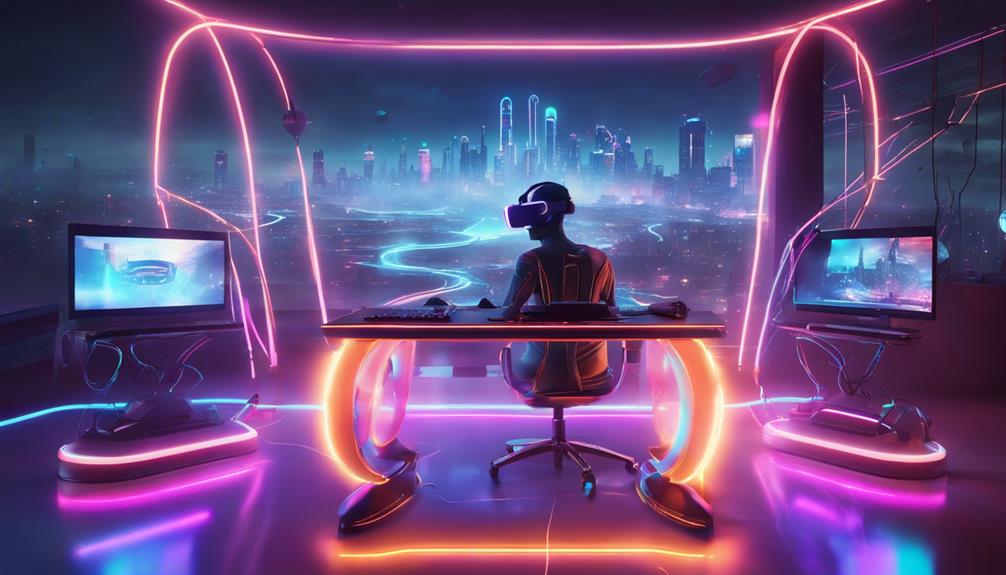
The Enchantment of Virtual Reality in Modern Gaming
Virtual reality has transformed the gaming industry by offering immersive experiences that replicate real-life settings, nurturing deeper emotional bonds and an enhanced sense of immersion. Interactive stories empower players to influence the plot, as accurate haptic feedback and lifelike sound design amplify emotional reactions. Social VR gaming changes how players interact, allowing for stronger connections and understanding. Progress in VR hardware and accessories propels advancement, promising even more engaging experiences. As VR technology progresses, it's evident that the magic of virtual reality is just starting to reveal itself, with new opportunities ready to be explored.
Immersive Storytelling in VR Games
Virtual reality technology has transformed the way gamers experience stories, allowing for unprecedented levels of involvement through interactive, 360-degree environments that transport players into the core of the narrative. This heightened sense of presence enables gamers to form deeper emotional connections with characters and storylines, nurturing a level of emotional depth previously unachievable in traditional gaming. Interactive narratives, where players' decisions and actions directly influence the story, further amplify this emotional investment. The agency granted to players allows them to shape the narrative, creating a sense of ownership and responsibility that enriches the overall gaming experience.
Branching storylines, a hallmark of VR gaming, offer multiple paths for players to explore, each with unique consequences and outcomes. This dynamic storytelling approach not just increases replay value but also encourages players to experiment and explore different narrative threads. As a result, gamers are no longer passive observers but active participants in the story, driving the plot forward with their choices. The synergy between player agency and branching storylines creates a rich, immersive experience that draws players into the gaming world. By utilizing these innovative storytelling techniques, VR games have redefined the boundaries of narrative engagement, offering a new frontier in gaming that is both enthralling and unforgettable.
Enhanced Player Engagement Levels
Mastery of the gaming environment is redefined as VR technology seamlessly integrates intuitive controls, realistic sound design, and precise haptic feedback, collectively elevating player engagement to unprecedented levels. This synergy of sensory stimulation and cognitive involvement nurtures an emotional bond between the player and the virtual world, resulting in a more immersive experience.
| Aspect | Impact on Engagement | Benefits |
|---|---|---|
| Intuitive Controls | Improves player interaction | Enhanced precision and accuracy |
| Realistic Sound Design | Intensifies sensory stimulation | Increased emotional response |
| Precise Haptic Feedback | Deepens emotional connection | Greater sense of immersion |
As players become more invested in the game, their emotional connection grows, and their cognitive involvement is heightened. This, in turn, leads to increased player interaction, as they aim to master the virtual environment. The fusion of these elements enables VR games to transcend traditional gaming experiences, offering a new level of engagement that is both enthralling and unforgettable. By leveraging the full potential of VR technology, game developers can create experiences that entertain, inspire, and emotionally resonate with players. Ultimately, the future of gaming lies in tapping into the potential of VR to forge deeper connections between players and the virtual world.
New Avenues for Game Development
The advent of virtual reality has opened up new avenues for game development, allowing developers to craft immersive gameplay experiences that transport players to unprecedented levels of engagement. By leveraging VR's unique capabilities, game creators can also enrich storytelling capabilities, weaving intricate narratives that resonate more deeply with players. As the industry continues to explore the possibilities of VR, we can expect to see innovative titles that redefine the boundaries of interactive entertainment.
Immersive Gameplay Experiences
Sophisticated graphics and haptic feedback have converged to create immersive gameplay experiences that redefine the boundaries of interactive storytelling in modern gaming. This synergy enables gamers to engage with virtual worlds on a deeper level, nurturing a sense of sensory immersion that simulates real-life experiences. Interactive environments respond to players' actions, allowing them to manipulate objects, navigate spaces, and interact with non-playable characters in a lifelike manner.
Realistic simulations and virtual interactions further enrich the sense of immersion, blurring the lines between the physical and virtual domains. Gamers can now experience the excitement of skydiving, explore the depths of the ocean, or engage in high-stakes combat without leaving their seats. The fusion of innovative graphics and haptic feedback creates an unparalleled level of realism, making it increasingly challenging to distinguish between the virtual and real worlds. Consequently, gamers are treated to a genuinely immersive experience that reshapes the boundaries of modern gaming.
Enhanced Storytelling Capabilities
As gamers increasingly immerse themselves in virtual worlds, the boundaries of storytelling are expanding, revealing new paths for game development that utilize the emotional impact of interactive narratives. Virtual reality (VR) technology has allowed developers to create experiences that transport players into the core of the story, nurturing a deeper sense of emotional involvement. This, in turn, has sparked innovative storytelling methods that blend the lines between player and protagonist.
Dynamic character growth is now achievable, as VR enables players to impact the narrative through their actions and choices. This level of player agency empowers gamers to mold the story, creating a distinct experience that is both personalized and captivating. Moreover, VR enables developers to design intricate, multi-faceted characters that develop over time, reacting to the player's actions and feelings. By utilizing the potential of interactive narratives, VR has unearthed new possibilities for immersive storytelling, redefining the gaming experience and pushing the limits of what is achievable in modern game development.
The Rise of Social VR Gaming
In the domain of virtual reality, a seismic shift is underway, driven by the convergence of social interaction and immersive gaming experiences. The rise of social VR gaming has transformed the gaming scenery, redefining the way players interact, collaborate, and socialize. Virtual worlds have become the new playground, where gamers can engage in rich social interactions, forge lasting bonds, and build thriving communities.
Social interaction is at the heart of this revolution, as VR technology enables gamers to connect with others on a deeper level. Players can communicate, cooperate, and even empathize with one another in ways that were previously impossible. Virtual worlds have become incubators for community building, where gamers can forge online friendships that transcend geographical boundaries. These digital relationships are built on trust, mutual respect, and a shared passion for gaming, nurturing a sense of belonging and camaraderie.
As VR technology continues to evolve, social VR gaming is poised to reach new heights. With the ability to create increasingly realistic and immersive experiences, gamers will be able to engage with each other in ways that are both authentic and engaging. The future of gaming is undoubtedly social, and VR is at the forefront of this revolution. As the boundaries between the physical and virtual worlds continue to blur, one thing is clear: social VR gaming is here to stay, and it's changing the face of modern gaming forever.
VR Hardware and Accessories Evolve
Advancements in VR hardware and accessories have been pivotal in driving the growth of social VR gaming, providing gamers with more intuitive and immersive experiences that foster deeper connections and interactions. The development of high-resolution VR goggles, for example, has greatly improved the visual fidelity of virtual environments, allowing gamers to fully engage themselves in intricately detailed worlds. Moreover, the incorporation of haptic feedback technology has enabled a more tactile and captivating experience, allowing gamers to sense tactile sensations, such as texture and weight, in a virtual setting.
The evolution of VR controllers has also played a vital role in enriching the sense of presence and control in virtual environments. Advanced controllers now offer a variety of gestures and motions, enabling gamers to interact with virtual objects in a more natural and intuitive way. Additionally, the creation of specialized accessories, like VR-compatible keyboards and gamepads, has further broadened the possibilities of social VR gaming.
As VR hardware and accessories continue to progress, we can anticipate even more advanced and immersive experiences to arise. With the capability to track eye movements, facial expressions, and even brain activity, the potential for truly groundbreaking VR experiences is extensive. As the technology advances, social VR gaming is primed to become even more captivating, interactive, and interconnected, reshaping the boundaries of modern gaming.
Overcoming Technical Challenges Ahead
Frequently, the most noteworthy obstacles to widespread adoption of social VR gaming lie in the technical challenges that must be overcome, including latency, resolution, and content creation. These challenges can greatly impact the user experience, leading to frustration and disengagement. To overcome these technical challenges, the industry is focusing on technical innovations that can optimize game performance and enrich the overall user experience.
| Technical Challenge | Solution |
|---|---|
| Latency | Advanced rendering techniques, such as asynchronous time warping, to decrease latency and motion sickness |
| Resolution | Development of higher-resolution displays and graphics processing units (GPUs) to improve visual fidelity |
| Content Creation | Advancements in game engines, such as Unreal Engine and Unity, to streamline and expedite content creation |
Game optimization is crucial to ensuring a seamless user experience. By leveraging technical innovations, game developers can reduce latency, enhance resolution, and create engaging content that immerses players in the virtual world. Effective interface design is also crucial, as it enables users to navigate the virtual environment intuitively and effortlessly. By addressing these technical challenges, the industry can unlock the full potential of social VR gaming, providing users with an unparalleled level of immersion and engagement.
Popular VR Games and Experiences
The current VR gaming panorama presents a wide array of captivating titles and experiences that cater to diverse preferences and tastes. From action-packed escapades to stimulating puzzles, top VR titles have redefined the gaming encounter. Games like Beat Saber, Job Simulator, and Superhot VR have become immediate classics, delivering an unmatched level of immersion and interactivity. These titles have not only demonstrated the potential of VR but have also established a high standard for upcoming developers.
In addition to gaming, must-attempt VR encounters have surfaced as a notable aspect of the VR environment. Experiences like Google Earth VR, National Geographic Explore VR, and TheBlu enable users to explore novel realms, visit unique locations, and engage with breathtaking surroundings. These encounters have paved the way for education, exploration, and entertainment, further nurturing the expansion of VR.
The popularity of these titles and encounters can be credited to their capacity to provide an unparalleled feeling of presence and immersion. By utilizing the capabilities of VR, developers have crafted captivating experiences that transport users to fresh dimensions, cultivating a deeper bond with the virtual world. As the VR scenery continues to progress, it’s thrilling to observe what new titles and encounters will surface, continuously pushing the limits of this groundbreaking technology. These innovative experiences not only enhance entertainment but also pave the way for new applications in education, therapy, and social interaction. As creators harness seamless technology in user experiences, they are breaking down barriers that once limited human connection and understanding. The potential for VR to create shared moments, regardless of physical distance, is revolutionizing how we perceive and engage with the world around us.
The Future of VR in Gaming
Several compelling trends are emerging in the VR gaming arena, hinting at a transformative future where immersive experiences become even more sophisticated and mainstream. As VR technology advances, we can expect to see significant improvements in VR game design, leading to more engaging and interactive experiences.
| Trend | Impact on VR Gaming |
|---|---|
| Advancements in Haptic Feedback | Enriched sense of immersion and realism |
| Increased Adoption of Cloud Gaming | Seamless, high-quality VR experiences on various devices |
| Development of Social VR Platforms | New opportunities for social interaction and multiplayer gameplay |
| Integration of AI and Machine Learning | More realistic NPC behaviors and dynamic game environments |
| Advancements in Eye-Tracking Technology | Improved foveated rendering and more realistic gaze-based interactions |
These trends will not just elevate the quality of VR games but also broaden their reach to a wider audience. As VR becomes more accessible and affordable, we can anticipate a surge in mainstream adoption. This, in turn, will drive innovation and investment in VR game design, leading to even more sophisticated and engaging interactive experiences.
As the VR gaming landscape continues to evolve, it's crucial for developers and gamers alike to stay ahead of the curve. By embracing these emerging trends, we can unleash the full potential of VR and create immersive experiences that transport us to new worlds and push the boundaries of human interaction.
Frequently Asked Questions
Can I Use VR Headsets With Prescription Glasses?
When incorporating virtual reality (VR) into daily life, individuals with prescription glasses often wonder if they can utilize VR headsets with their corrective lenses. Consider Sarah, a gamer who relies on her glasses to correct her nearsightedness. Fortunately, many VR headsets offer lens inserts, ensuring compatibility with prescription glasses. By adjusting settings and finding the perfect fit, users like Sarah can experience immersive VR with maintaining best comfort and visual clarity.
Will VR Gaming Cause Motion Sickness or Eye Strain?
When engaging in immersive virtual reality experiences, it's important to prioritize comfort and safety. To mitigate adverse effects, preventing motion sickness and managing eye strain are vital. Adjusting headset settings, taking regular breaks, and maintaining a comfortable playing environment can greatly reduce the risk of discomfort. Moreover, ensuring proper eye alignment and focusing on visual clarity can help minimize eye strain, allowing for an uninterrupted and enjoyable experience.
Are VR Games Only Available on High-End Gaming Pcs?
Just as a master chef can whip up a gourmet meal in a humble kitchen, VR gaming is no longer reserved for high-end gaming PCs. While top-tier rigs provide best performance, budget options now offer VR compatibility, making the experience more accessible. In fact, console giants like PlayStation and Oculus have introduced affordable VR gaming solutions, broadening accessibility options for enthusiasts.
Can I Use VR Headsets With Consoles Like PS4 or Xbox?
In terms of console gaming, VR compatibility is a significant concern. PS4 and Xbox consoles do support VR headsets, yet their restrictions impede the complete VR immersion experience. The processing capability and graphics performance of these consoles are not comparable to high-end gaming PCs, leading to decreased frame rates and resolutions. This trade-off can diminish the overall gaming experience, making PC-based VR a more suitable choice for those looking for peak performance.
Are VR Games More Expensive Than Traditional Games?
When comparing the cost of VR games to traditional titles, a notable price disparity exists. On average, VR games tend to be pricier, with prices ranging from $20 to $60 or more. This is mainly because of the complexity of developing immersive VR experiences, which necessitates substantial investments in hardware compatibility and game libraries. As a result, VR gamers often face higher price points, making it crucial to weigh the cost-benefit ratio before delving into the virtual world.

Related Posts

The Top Tools for Empowering Creative Developers in 2024

How Creative Coding Is Bridging Art and Technology
