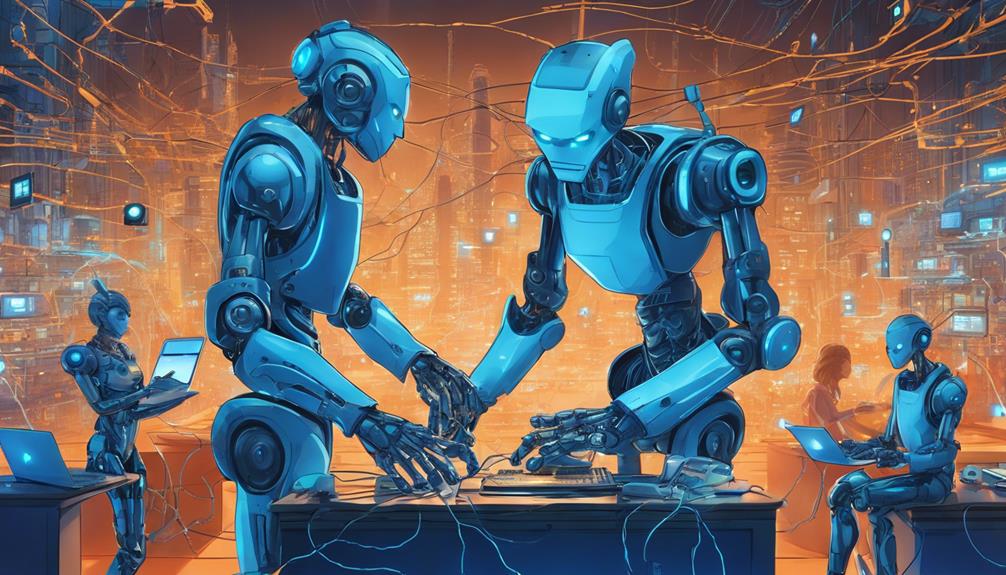
The Role of Artificial Intelligence in Future Job Markets
Artificial intelligence is reshaping the future job market, displacing certain occupations whilst creating new ones. As AI automation replaces repetitive tasks, workers must adapt and develop valuable skills that machines cannot replicate. New roles in AI training, data analysis, and cybersecurity are emerging, requiring skills like creativity, critical thinking, and adaptability. Human skills like collaborative creativity, emotional intelligence, and problem-solving are becoming increasingly valuable. To thrive in an automated economy, workers must recognize and prepare for future job opportunities by developing new skills and staying updated with industry trends. The future of work depends on it, and there's more to explore.
AI-Driven Job Displacement
As artificial intelligence increasingly permeates various industries, it is giving rise to a pressing concern: the displacement of human workers, with automation potentially rendering certain jobs obsolete. The automation impact on job security is a growing worry, as machines and algorithms begin to assume tasks that were previously the domain of human workers. This shift is not limited to any particular sector, with AI-driven automation affecting everything from manufacturing and logistics to customer service and data analysis.
A significant concern is that AI-powered machines can perform tasks with greater speed, accuracy, and efficiency than their human counterparts. This has led to fears that many jobs will become redundant, leaving workers without a means of supporting themselves. The impact on job security is already being felt, with many employees facing uncertainty about their future employment prospects.
The automation impact on job security is particularly pronounced in industries where tasks are repetitive or can be easily automated. Workers in these sectors are at risk of being displaced, and may struggle to find new employment opportunities. As AI continues to advance, it is crucial that policymakers, business leaders, and educators work together to address the challenges posed by AI-driven job displacement and guarantee that workers have the skills needed to thrive in an increasingly automated economy. Furthermore, it is essential to implement retraining programs that can equip displaced workers with skills relevant to emerging industries. By fostering a culture of lifelong learning, we can mitigate the negative impacts of automation on jobs and help individuals transition into new roles that require a different skill set. Ultimately, a collaborative approach involving various stakeholders will be critical in managing the broader societal impacts of automation on jobs and ensuring a just and equitable workforce transformation.
Emerging Job Opportunities
AI-driven job displacement poses significant challenges, it creates new opportunities for workers to adapt and thrive in emerging roles that leverage the strengths of both humans and machines. While AI automates routine tasks, it also enables the creation of new job categories that require human skills such as creativity, empathy, and critical thinking.
As we progress towards a more automated workforce, new opportunities are emerging in areas such as:
- AI Training and Development: With the increasing need for AI systems, professionals who can develop, train, and maintain these systems will be in high demand.
- Data Analysis and Interpretation: As AI generates vast amounts of data, professionals who can analyze and interpret this data to inform business decisions will be crucial.
- Digital Transformation Consulting: With the rise of remote work and the gig economy, companies will need consultants who can guide them through digital transformations and help them adapt to changing work environments.
- Cybersecurity: As AI systems become more prevalent, cybersecurity experts will be required to protect against potential threats and vulnerabilities.
These emerging roles require workers to develop new skills and adapt to changing work environments. As we navigate the future of work, it's vital to recognize the opportunities that AI presents and prepare workers for the jobs of tomorrow. By doing so, we can ensure that the benefits of AI are shared by all and that workers can thrive in an automated workforce.
Human Skills in Demand
As automation takes over routine tasks, human skills such as creativity, emotional intelligence, and complex problem-solving abilities will become increasingly valuable in the future job market. These skills, often referred to as 'human touch' skills, are hard to replicate with AI and will be in high demand.
| Human Skills in Demand | Description |
|---|---|
| Collaborative Creativity | Ability to work with others to generate innovative solutions |
| Emotional Intelligence | Capacity to understand and manage one's own emotions and those of others |
| Complex Problem-Solving | Ability to analyze and resolve complex, dynamic problems |
| Adaptability | Capacity to adapt to changing circumstances and priorities |
In a future where AI handles routine tasks, humans will be free to focus on higher-level thinking, creativity, and emotional intelligence. The ability to collaborate with others, think creatively, and empathize with colleagues and customers will become vital skills. Employers will seek individuals who can navigate complex problems, adapt to new situations, and provide exceptional customer experiences. As AI augments human capabilities, the demand for human skills like emotional intelligence, collaborative creativity, and complex problem-solving will keep increasing. By developing these skills, individuals can not just complement AI but also thrive in the future job market.
Education and Retraining Needs
To prepare workers for a future where human skills take center stage, the education system and employers must prioritize retraining and upskilling programs that nurture the development of collaborative creativity, emotional intelligence, and complex problem-solving abilities. This shift in focus is pivotal, as artificial intelligence (AI) continues to automate routine and repetitive tasks, making human skills more valuable than ever.
To achieve this, the following strategies are crucial:
- Highlight continuous learning: Encourage workers to engage in lifelong learning, staying up-to-date with the latest technological advancements and industry trends.
- Develop interdisciplinary skills: Cultivate collaboration between different disciplines, such as STEM fields, humanities, and social sciences, to create well-rounded professionals.
- Integrate AI-powered tools: Utilize AI-driven platforms to enrich the learning experience, providing personalized feedback and adaptive learning pathways.
- Nurture a culture of innovation: Encourage experimentation, creativity, and risk-taking, allowing workers to develop novel solutions to complex problems.
Future of Workforce Development
Workforce development in the future will require a paradigm shift, where employers and educators collaborate to create agile, adaptable, and resilient workers capable of thriving in an environment of rapid technological change. This shift will necessitate a focus on skill adaptation, enabling workers to continuously upskill and reskill to remain relevant in an increasingly automated job market. Remote work will also become a norm, with workers requiring the ability to effectively communicate and collaborate in virtual environments.
The automation impact on jobs will be significant, with many traditional roles becoming obsolete. Nevertheless, this also presents opportunities for new job creation and the emergence of new industries. The gig economy will continue to grow, providing workers with the flexibility to choose from a variety of projects and assignments. To prepare workers for this new reality, workforce development programs must prioritize skills such as creativity, critical thinking, and problem-solving.
Employers and educators must work together to create training programs that are responsive to the changing needs of the job market. This will involve a shift from traditional degree-based education to more modular and flexible learning pathways. By prioritizing skill adaptation, remote work, and gig economy readiness, we can guarantee that workers are equipped to thrive in the future job market. In the end, the success of workforce development will depend on our ability to adapt to the changing terrain of work and prepare workers for the opportunities and challenges that lie ahead.
Frequently Asked Questions
Will AI Be Able to Replace Human Creativity and Innovation Entirely?
AI can process vast amounts of data, human creativity and innovation flourish in the domain of the unknown. The juxtaposition of creativity vs automation emphasizes the limitations of AI in reproducing human ingenuity. Innovation, arising from intuition and imagination, cannot be completely substituted by algorithms. AI can enhance human capabilities, but the spark of creativity stays an inherently human characteristic, guaranteeing that AI will not entirely replace human innovation.
How Will AI Affect the Job Market for People With Disabilities?
Individuals with disabilities may encounter both advantages and obstacles as AI revolutionizes the job market. Conversely, AI-driven workplace adaptations can improve accessibility, empowering individuals with disabilities to work more efficiently. Conversely, AI may replace specific roles, possibly worsening current obstacles to employment opportunities. To foster inclusion, it is crucial to guarantee that AI is created and implemented with accessibility in consideration, generating new job prospects that appreciate varied skills and viewpoints.
Can AI Be Biased Towards Certain Groups or Demographics?
Can AI systems perpetuate biases toward specific groups or demographics? Certainly, they can. Prejudiced data and flawed algorithms can lead to unjust outcomes, worsening current social disparities. The ethical implications of AI bias are extensive, highlighting the necessity for data accuracy and fairness considerations. To lessen these risks, algorithm transparency is vital, allowing for the detection and correction of biases. By emphasizing fairness and transparency, we can guarantee AI systems benefit everyone, not only a chosen few.
Will AI Increase the Wealth Gap Between the Rich and the Poor?
The widening wealth gap between the rich and the poor is a pressing concern. Unfortunately, AI may exacerbate economic disparities by disproportionately benefiting high-skilled, high-income individuals. As automation replaces low-skilled jobs, those already struggling may be left behind, further entrenching social inequality. The workforce impact will be significant, with the wealthy reaping most benefits from technological advancement, whilst the poor face potentially devastating consequences.
Can AI Be Used to Monitor and Regulate Its Own Ethics?
The question of whether AI can be used to monitor and regulate its own ethics is an important one. Establishing ethical oversight in AI development is necessary to guarantee accountability. Implementing AI-driven monitoring systems can help detect and prevent unethical behavior. Yet, this raises concerns about AI accountability and the need for clearly defined ethical guidelines. Effective regulation requires a nuanced approach, balancing autonomous decision-making with human oversight to prevent bias and promote responsible AI development.

Related Posts

Why Understanding the Context Matters in Today’s News

The Power of Curiosity in Uncovering Hidden Stories