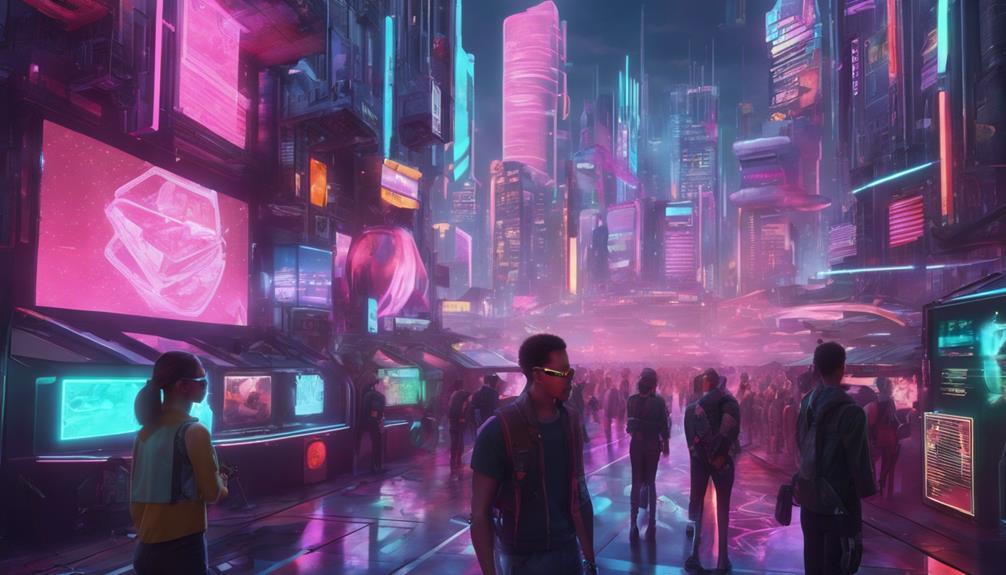
The Future of Augmented Reality: What’s Next
As augmented reality (AR) continues to evolve, its impact will be felt across various industries and aspects of life. From revolutionizing education and healthcare to transforming retail and gaming, AR's potential applications are becoming limitless. Advancements in hardware, the rise of AR Cloud, and innovations in gaming experiences are driving this growth. With AR's ability to boost accessibility, blur lines with virtual reality, and transform the way we interact, the possibilities are vast. As AR further integrates into our daily lives, exciting developments await, and the future of this technology is set to unfold in unprecedented ways.
AR in Everyday Life
As augmented reality (AR) technology continues to advance, it is becoming increasingly integrated into various aspects of our daily lives, from virtual try-ons at makeup counters to immersive educational experiences in classrooms. One area where AR is making a significant impact is in the fitness industry. AR fitness experiences are revolutionizing the way we exercise, providing users with personalized workout routines, real-time feedback, and immersive environments that make physical activity more engaging and enjoyable. For instance, AR-powered fitness apps allow users to visualize their workouts in 3D, track their progress, and even compete with friends.
The fashion industry is another sector where AR is transforming the way we shop and interact with clothing. AR in fashion allows customers to virtually try on clothes, see how they would look in different colors and styles, and even visualize how garments would fit without having to physically try them on. This technology is enhancing the customer experience and reducing returns while increasing sales for retailers. Additionally, AR is being used in fashion design, enabling designers to create digital prototypes, visualize their designs in 3D, and make adjustments in real-time. As AR continues to evolve, we can expect to see even more innovative applications in various aspects of our daily lives, further blurring the lines between the physical and digital worlds.
Advancements in AR Hardware
As augmented reality continues to evolve, significant advancements are being made in the development of AR hardware. Particularly, enhanced display technology is enabling more vivid and lifelike visuals, whilst sophisticated tracking systems are allowing for more precise and seamless interactions. These hardware innovations are poised to transform the AR experience, opening up new possibilities for users across various industries and applications.
Improved Display Technology
Microelectromechanical systems (MEMS) and other nanoscale technologies are revolutionizing augmented reality (AR) display technology, enabling the creation of higher-resolution, faster, and more energy-efficient micro-displays that can seamlessly merge digital information with the physical environment. These advancements are transforming the user experience, providing unparalleled display improvements that immerse users in rich, interactive environments. Next-generation screens are being developed to deliver unprecedented visual immersion, with higher pixel densities, faster refresh rates, and improved color accuracy. This enables AR experiences that are more realistic, engaging, and intuitive, blurring the lines between the physical and digital worlds. As a result, users can expect more sophisticated and interactive AR experiences that simulate real-world environments, revolutionizing industries such as education, entertainment, and healthcare. With improved display technology, AR is poised to open up new possibilities for human-computer interaction, redefining the boundaries of what is possible in the virtual and physical domains.
Advanced Tracking Systems
Advancements in AR hardware are yielding sophisticated tracking systems that can pinpoint the user's gaze, track subtle hand movements, and detect environmental changes, thereby enabling a new level of precision and immersion in augmented reality experiences. These advanced tracking systems are energized by precise sensors and advanced algorithms that can interpret complex data in real-time. This enables AR devices to accurately detect and respond to the user's movements, creating a seamless and intuitive interaction. For instance, advanced eye-tracking systems can identify what the user is looking at, allowing for precise object recognition and manipulation. Similarly, hand-tracking systems can detect subtle gestures, enabling users to interact with virtual objects in a more natural way. The implications of these advanced tracking systems are far-reaching, enabling new applications in fields such as education, healthcare, and entertainment. As AR technology continues to evolve, we can expect to see even more sophisticated tracking systems that blur the lines between the physical and digital worlds.
The Rise of AR Cloud
The concept of AR Cloud, a cloud-based infrastructure that enables augmented reality experiences to be shared and persisted across devices and users, is gaining significant traction within the industry. This revolutionary technology has the potential to transform the way we interact with AR, providing a seamless and persistent experience that transcends device boundaries.
Cloud integration is a critical component of AR Cloud, allowing for the storage and processing of vast amounts of data. This raises concerns about data privacy, as sensitive information is being stored and transmitted across the cloud. To address this, AR Cloud providers must prioritize robust security measures and transparent data management practices, ensuring that users' data is protected and respected.
The AR Cloud further enables social interaction and community building, allowing users to share and collaborate on AR experiences in real-time. This opens up new avenues for social engagement, education, and entertainment, as users can connect with others who share similar interests and passions. The rise of AR communities will be a key driver of adoption, as users seek out new and innovative ways to interact with others in the AR space. As the AR Cloud continues to evolve, we can expect to see new and exciting applications emerge, further solidifying its position as a game-changer within augmented reality.
Immersive Gaming Experiences
In the world of immersive gaming experiences, augmented reality is poised to transform the industry by introducing unprecedented levels of engagement and interaction. With the ability to transport players into intricately detailed virtual worlds, AR gaming will enable exploration and discovery on an unparalleled scale. Moreover, innovative storytelling modes and smooth shifts between gameplay sequences will further blur the lines between the physical and virtual domains.
Virtual World Exploration
Eighty percent of gamers surveyed prioritize immersive experiences, driving the development of virtual world discovery in augmented reality. This demand has led to the creation of unparalleled gaming adventures, allowing players to venture into unexplored territories and reenact historical events like never before. In virtual world discovery, gamers can set off on space travel and exploration, journeying through celestial bodies and uncovering new worlds. This level of immersion is unmatched, providing an exceptional sense of presence and control.
Furthermore, historical reenactments and simulations are becoming increasingly popular, enabling players to relive pivotal moments in history. From ancient battles to groundbreaking discoveries, these experiences allow gamers to step into the roles of historical figures and influence the course of events. The level of intricacy and precision in these simulations is remarkable, making them feel astonishingly realistic. As virtual world discovery continues to progress, we can expect even more advanced and captivating experiences that blur the boundaries between reality and imagination.
Interactive Storytelling Modes
More than 90% of gamers desire narrative-driven experiences, fueling the evolution of interactive storytelling modes that seamlessly merge gameplay and cinematic elements. This fusion enables players to become an integral part of the storyline, influencing the narrative's trajectory through their actions. One of the most promising developments in this domain is the rise of interactive characters, which can respond to player inputs and adapt to the situation, creating a more immersive experience.
Branching narratives take this concept to the next level, allowing players to make choices that have tangible consequences on the story's progression. This level of agency empowers gamers, making them feel like masters of their virtual destiny. As AR technology advances, we can expect to see even more sophisticated interactive storytelling modes emerge, further blurring the lines between player and protagonist. The potential for AR to redefine the gaming landscape is vast, and it's exciting to contemplate the possibilities that lie ahead. By utilizing the potential of interactive storytelling, AR has the ability to transport gamers to new dimensions, redefining the very essence of gaming itself.
Seamless Gameplay Transitions
As augmented reality continues to blur the boundaries between the physical and virtual worlds, smooth gameplay shifts emerge as an important component in crafting truly immersive gaming experiences. To achieve this, AR technology must facilitate seamless switches between different gameplay scenarios, ensuring a cohesive and engaging experience for players. This necessitates the development of advanced algorithms and rendering engines capable of handling complex scene changes without interruption or lag.
Smooth gameplay transitions are critical in elevating the overall gaming experience, allowing players to fully immerse themselves in the virtual environment. Next-level interaction is achieved when the boundaries between the physical and virtual worlds dissolve, creating a truly immersive experience. By eliminating abrupt transitions and interruptions, AR technology can create a more realistic and engaging experience, drawing players deeper into the game world. As the industry continues to push the boundaries of AR, smooth gameplay transitions will play an increasingly important role in shaping the future of gaming. By perfecting this aspect, developers can access new levels of immersion and interaction, redefining the gaming scenery.
AR's Impact on Education
Educators are increasingly acknowledging the potential of augmented reality to transform the learning experience by providing students with interactive, three-dimensional visualizations that enrich their grasp of complex concepts. By integrating AR in classrooms, teachers can boost student engagement and create a more immersive learning environment. Studies have shown that students who use AR-based learning tools exhibit higher levels of participation and motivation, leading to improved academic outcomes.
Augmented learning experiences, such as educational simulations, offer a unique opportunity for students to interact with virtual objects and environments that would be impossible or impractical to replicate in real life. This enables students to explore complex systems and phenomena in a safe and controlled manner, nurturing a deeper comprehension of abstract concepts. For instance, students can use AR to dissect virtual frogs, explore the inner workings of the human body, or visualize the movement of celestial bodies. These interactive simulations not only enrich student engagement but also cultivate critical thinking, problem-solving, and collaboration. As AR technology continues to evolve, we can expect to see even more innovative applications in education, revolutionizing the way we learn and interact with complex information.
Virtual Try-On and Shopping
Augmented reality is transforming the retail industry, where virtual try-on and shopping experiences are redefining the way consumers interact with products and make purchasing decisions. Fashion simulation technology enables customers to virtually try on clothing, accessories, and even hairstyles, eliminating the need for physical fitting rooms. Online fitting rooms are becoming increasingly popular, allowing shoppers to visualize themselves in various outfits without having to physically change clothes.
In the beauty industry, digital cosmetics are reshaping the way consumers engage with makeup products. Virtual makeup tutorials enable users to virtually apply makeup, allowing them to test different looks and products without having to physically apply them. This technology not just improves the shopping experience but also reduces the risk of returns and increases customer satisfaction.
AR-powered virtual try-on and shopping experiences are also boosting sales and revenue for retailers. By providing an immersive and personalized experience, customers are more likely to make a purchase, and retailers can reduce costs associated with returns and inventory management. As AR technology continues to evolve, we can expect to see even more innovative applications in the retail industry, further blurring the lines between online and offline shopping. With its ability to enrich customer engagement, drive sales, and reduce costs, AR is positioned to transform the retail industry and redefine the future of shopping.
Healthcare and AR Therapy
Besides retail, augmented reality is revolutionizing the healthcare sector, wherein AR therapy is emerging as a promising tool for addressing a wide array of medical conditions. In rehabilitation therapy, AR is utilized to boost patient engagement and motivation, leading to more effective treatment results. By offering immersive and interactive experiences, AR therapy empowers patients to actively participate in their recovery process, resulting in quicker and more sustainable progress.
Furthermore, AR is transforming medical training and education. Surgical simulations, for instance, are becoming increasingly advanced, enabling medical professionals to refine their skills in a realistic and low-risk setting. This not just enhances their confidence and competence but also decreases the likelihood of complications during real surgeries. Additionally, AR-based medical training allows healthcare providers to practice complex procedures repeatedly, perfecting their techniques and staying current with the latest advancements in medical science.
The influence of AR on healthcare is undeniable, and its capacity to enhance patient outcomes, decrease costs, and improve the overall quality of care is extensive. As the technology progresses, we can anticipate even more innovative applications of AR in healthcare, ranging from remote consultations to personalized medicine. As the healthcare industry continues to embrace AR, it is evident that this technology will have a crucial role in shaping the future of medical care.
Remote Work and Collaboration
As the global workforce becomes increasingly scattered, augmented reality is positioned to transform remote work and collaboration by providing immersive, interactive, and engaging virtual environments that replicate in-person interactions. Virtual meetings will no longer be limited to monotonous video conferencing, but instead, participants will be able to engage in remote brainstorming sessions that feel as organic as being in the same room. This shift will transform the way teams collaborate, nurturing creativity, productivity, and innovation.
Digital collaboration will reach new peaks with AR teamwork, enabling colleagues to work together on intricate projects in a shared, virtual space. This will facilitate smooth communication, reducing misunderstandings and mistakes, while enhancing efficiency and accuracy. AR-powered virtual whiteboards, 3D models, and interactive simulations will become crucial tools for remote teams, allowing them to visualize and interact with intricate data in a more instinctive and engaging manner.
As a result, remote work will become more inclusive, flexible, and effective, breaking down geographical barriers and enabling global teams to work together as if they were physically present. With AR, the distinctions between remote and in-person collaboration will blend, creating a new era of flexible, high-performance teamwork. As the remote workforce continues to expand, AR will play a vital role in shaping the future of work, enabling teams to collaborate, innovate, and thrive in a swiftly changing world.
AR in Architecture and Design
As architects and designers increasingly adopt augmented reality (AR) technology, they are discovering new ways to reimagine the design process. By leveraging AR, professionals can now explore virtual building models, improve design visualization, and interact with 3D prototypes in unprecedented ways. These innovative applications have the potential to transform the architecture and design industries, enabling faster, more accurate, and more sustainable project development.
Virtual Building Exploration
Nearly 90% of architecture, engineering, and construction (AEC) professionals rely on 2D blueprints and physical models to visualize and communicate building designs, but augmented reality (AR) is positioned to transform this process through virtual building exploration.
Virtual building exploration enables AEC professionals to immerse themselves in architectural simulations, providing an unparalleled level of design innovation. By utilizing AR, architects can create virtual constructions that allow stakeholders to explore and interact with building designs in a highly immersive and engaging manner.
| Benefits | Description |
|---|---|
| Improved Collaboration | Enhanced communication among stakeholders through interactive 3D models |
| Optimized Efficiency | Reduced need for physical prototypes and revised designs |
| Cost Savings | Minimized errors and miscommunication through immersive simulations |
| Enhanced Precision | Improved accuracy in design and construction through virtual exploration |
AR-powered virtual building exploration is revolutionizing the AEC industry by streamlining the design-to-construction process, reducing costs, and improving overall efficiency. As the technology continues to evolve, we can expect to see widespread adoption across the industry, transforming the way we design, build, and interact with our built environment.
Enhanced Design Visualization
Building on the potential of virtual building exploration, augmented reality is poised to transform the design visualization process, enabling architects and designers to bring their creative visions to life in unprecedented ways. By leveraging AR, design professionals can engage in collaborative brainstorming sessions, where they can interact with virtual 3D models, and iterate on design concepts in real-time. Interactive prototyping allows for rapid testing and refinement of ideas, streamlining the design process and reducing the risk of costly mistakes.
AR furthermore enables real-time design feedback, where stakeholders can provide input on design iterations, ensuring that the final product meets their needs and expectations. Virtual walkthroughs further enrich the design visualization experience, allowing architects and designers to immerse themselves in their creations, identify potential flaws, and optimize the design for functionality and aesthetics. By tapping into the potential of AR, architects and designers can unlock new levels of creativity, collaboration, and innovation, revolutionizing the design visualization process and redefining the boundaries of what is possible.
Interactive 3D Modeling
Within the field of architecture and design, interactive 3D modeling enabled by augmented reality is poised to redefine the boundaries of spatial comprehension, allowing designers to dynamically manipulate and refine intricate shapes and structures with unprecedented precision. This revolutionary technology is transforming the design process, facilitating interactive design and creative collaboration among stakeholders.
Key benefits of interactive 3D modeling in AR include:
- Enhanced creativity: AR enables designers to experiment with complex shapes and structures in real-time, sparking unparalleled levels of innovation.
- Improved communication: Interactive 3D models facilitate more effective communication among architects, engineers, and clients, reducing errors and misinterpretations.
- Streamlined workflows: Virtual prototyping and dynamic simulations enable designers to test and refine their designs in a more efficient and cost-effective manner.
- Increased accuracy: AR-powered interactive 3D modeling ensures precise calculations and simulations, reducing the risk of errors and costly reworks.
- Enhanced stakeholder engagement: Interactive 3D models enable clients and stakeholders to fully immerse themselves in the design, nurturing deeper understanding and buy-in.
The Future of AR Advertising
As augmented reality technology advances and becomes more accessible, advertisers are poised to reap significant benefits from its immersive and interactive capabilities. AR is revolutionizing the advertising realm by providing brands with new and innovative ways to connect with their target audience.
One of the most promising applications of AR in advertising is in branding and marketing. By leveraging AR, brands can create immersive and interactive experiences that engage customers on a deeper level. For instance, AR can be used to bring product packaging to life, allowing customers to interact with virtual product demos or tutorials.
| AR Advertising Benefits | Description |
|---|---|
| Increased Engagement | AR experiences are more captivating than traditional ads, leading to higher conversion rates |
| Personalization | AR allows brands to customize experiences to individual customers, increasing brand loyalty |
| Measurable ROI | AR campaigns can be accurately tracked, providing a clear return on investment |
| Competitive Advantage | Brands that adopt AR early will have a competitive edge over those that do not |
| Cost-Effective | AR reduces the need for physical product demonstrations and prototypes |
AR product placement is another area where the technology is making waves. By seamlessly integrating products into virtual environments, brands can create realistic and compelling product demos that simulate real-life experiences. This not just improves customer engagement but also drives sales and boosts brand awareness. As AR technology continues to evolve, we can expect to see even more innovative applications of AR in advertising, further blending the lines between the physical and digital worlds.
AR and Accessibility Features
Augmented reality technology is being leveraged to create innovative accessibility features that enable individuals with disabilities to interact with and navigate their surroundings in ways previously unimaginable. This fusion of AR and accessibility advancements is revolutionizing the way people with disabilities engage with the world around them.
Some notable examples of AR and assistive technology include:
- Visual assistance: AR-powered glasses can provide real-time object recognition, text-to-speech functionality, and facial recognition for individuals with visual impairments.
- Hearing assistance: AR-enabled hearing aids can amplify and clarify sounds, and provide real-time transcriptions and speech-to-text functionality.
- Motor skill assistance: AR-based systems can assist individuals with motor skill disabilities by offering virtual guidance and feedback on physical movements.
- Cognitive assistance: AR-powered tools can aid individuals with cognitive disabilities by offering step-by-step instructions, reminders, and organization assistance.
- Autism support: AR-based systems can offer individuals with autism social skills training, emotional regulation tools, and sensory integration therapy.
These AR and inclusivity features are enhancing the quality of life for individuals with disabilities and promoting user-friendly design and inclusivity in various aspects of life. As AR technology continues to evolve, we can expect to see even more innovative accessibility features that empower individuals with disabilities to fully participate in society.
Blurring Lines With Virtual Reality
The fusion of augmented reality with accessibility features is just one aspect of the broader technological domain, where the boundaries between AR and virtual reality (VR) are becoming increasingly blurred. As AR continues to advance, it's inevitable that it will converge with VR, giving rise to new and innovative applications. One such area is virtual collaboration, where AR and VR can combine to create immersive and interactive experiences that transcend physical boundaries. Envision, for instance, attending an AR concert where the performer is projected onto a virtual stage, allowing attendees to interact with the environment and each other in real-time.
Similarly, virtual collaboration platforms can leverage AR and VR to facilitate remote meetings and brainstorming sessions that feel more like in-person interactions. The lines between AR and VR are blurring, and it's becoming increasingly difficult to distinguish between the two. The convergence of these technologies will open up new possibilities for industries such as education, healthcare, and entertainment. As AR continues to push the boundaries of what's possible, it's likely that we'll see even more innovative applications emerge. The future of AR is bright, and its intersection with VR is poised to transform the way we interact, work, and play.
Frequently Asked Questions
Will AR Glasses Replace Smartphones in the Near Future?
As AR glasses continue to advance, the question arises: will they replace smartphones in the near future? Although AR glasses promise to transform productivity with hands-free computing, they still lack the convenience and ubiquity of smartphones. It’s unlikely that AR glasses will immediately substitute smartphones, but rather, they will complement them, offering a new paradigm for specific tasks and industries. Moreover, as future trends in computing technology evolve, we may see a deeper integration between AR glasses and smartphones, creating a seamless user experience. This could enable functionalities such as real-time notifications and augmented interfaces that enhance everyday tasks. Ultimately, while AR glasses may not fully replace smartphones, they will likely redefine how we interact with digital information and each other.
How Will AR Affect the Job Market and Employment Rates?
As augmented reality (AR) continues to transform industries, its impact on the job market will be significant. Although some tasks may become automated, new job opportunities will emerge. To mitigate potential employment disruptions, governments and corporations must invest in targeted training programs that equip workers with AR-specific skills. This proactive approach will enable workers to adapt to the evolving terrain and thrive in an AR-driven economy.
Are There Any Privacy Concerns With Widespread AR Adoption?
As we stand at the threshold of a revolution, a lurking shadow casts a dark silhouette – the specter of privacy concerns. With AR's pervasive grasp, the integrity of personal data hangs precariously in the balance. The stakes are high, and the question looms: will users be forced to surrender their autonomy in exchange for the convenience of AR? Data security and user consent become the linchpins in this delicate dance, where the fate of individual privacy hangs precariously in the balance.
Can AR Be Used to Treat Mental Health Disorders Effectively?
Augmented reality has shown promising potential in treating mental health disorders effectively. Virtual therapy sessions, for instance, can provide patients with immersive experiences that simulate real-life situations, allowing them to confront and overcome their fears in a controlled environment. This innovative approach has been shown to reduce anxiety and depression symptoms, offering a new frontier in mental health treatment.
Will AR Technology Be Affordable for the General Population Soon?
According to a recent report, the global AR market is projected to reach $198.17 billion by 2025, growing at a CAGR of 43.8%. As AR technology advances, an essential factor in its widespread adoption will be affordability. A cost analysis reveals that the current high prices of AR devices and software hinder accessibility. Nevertheless, market trends suggest that economies of scale and increasing competition will drive down costs, making AR technology more affordable for the general population in the near future.

Related Posts

The Top Tools for Empowering Creative Developers in 2024

How Creative Coding Is Bridging Art and Technology
