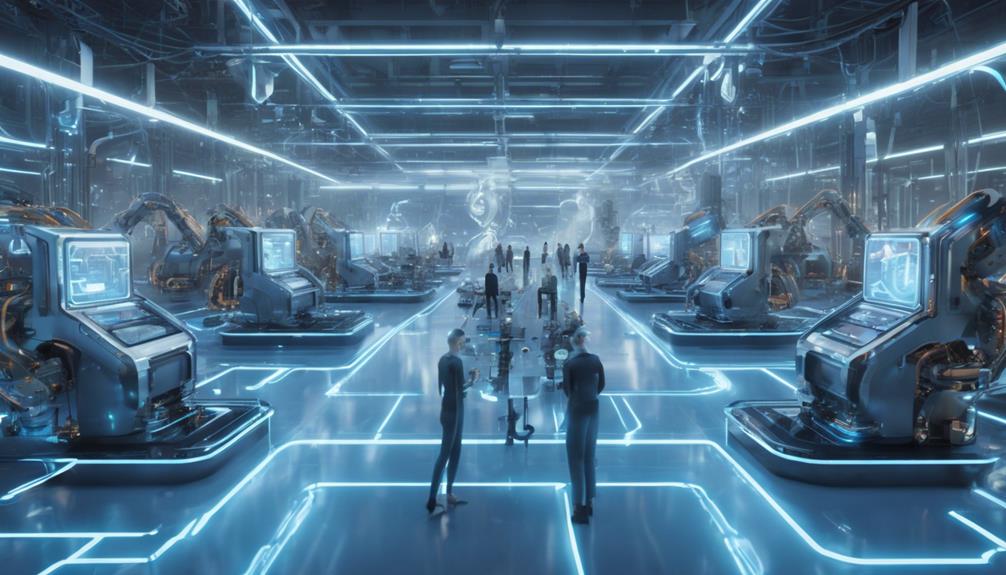
How Digital Twins Are Revolutionizing Manufacturing
Digital twins are transforming the manufacturing industry by creating virtual replicas of physical products, processes, and systems. This enables real-time simulation, analysis, and optimization, leading to improved product design, reduced prototyping costs, and improved predictive maintenance. Digital twins enhance production planning, reduce waste, and improve supply chain visibility. By leveraging digital twins, manufacturers can access new business models, innovate quality control, and drive innovation. As the industry continues to evolve, the full potential of digital twins is yet to be fully realized, and the most forward-thinking manufacturers are poised to reap the greatest rewards.
Boosting Product Design Efficiency
Boosting Product Design Efficiency
Utilizing digital twin technology, manufacturers can streamline their product design process by creating virtual replicas of physical products, thereby decreasing prototyping costs and speeding up time-to-market. This groundbreaking approach enables designers to test and refine their designs in a virtual environment, eliminating the need for physical prototypes and the related costs. With digital twins, manufacturers can conduct virtual simulation of their products, allowing for rapid iteration and optimization of design parameters. Additionally, this innovative technology not only enhances design efficiency but also facilitates real-time monitoring and maintenance throughout a product’s lifecycle. As manufacturers integrate digital twin technology with advanced manufacturing techniques, they are harnessing the potential of the future of 3D printing to create bespoke products tailored to specific customer needs. This synergy empowers businesses to respond more swiftly to market demands, ultimately leading to a more agile and competitive production landscape.
By simulating real-world scenarios, designers can identify and address potential design flaws and performance issues early on, reducing the risk of costly rework and delays. Additionally, digital twins enable real-time collaboration and data sharing among cross-functional teams, nurturing a more agile and responsive design process. With the capability to test and validate designs in a virtual environment, manufacturers can expedite their product development cycles, bringing innovative products to market faster and maintaining a competitive edge.
The advantages of digital twins in product design are undeniable. By reducing prototyping costs and expediting time-to-market, manufacturers can achieve significant cost savings and revenue gains. As the demand for customized and intricate products continues to increase, digital twin technology is positioned to play a critical role in propelling design innovation and efficiency in the manufacturing sector.
Streamlining Production Planning
In the field of production planning, digital twins are transforming the way manufacturers allocate resources and respond to demand. By creating a virtual replica of the production process, manufacturers can identify areas of inefficiency and optimize resource allocation to maximize output. Additionally, digital twins enable accurate demand forecasting, allowing manufacturers to proactively adjust production schedules to meet changing customer needs.
Optimized Resource Allocation
By leveraging digital twin technology, manufacturers can dynamically allocate resources to optimize production planning, ensuring that every element of the production process is aligned to meet exacting customer demands. This results in a significant reduction in waste, improved lead times, and increased customer satisfaction. Optimized resource allocation boosts enables manufacturers to reduce energy consumption, leading to cost savings and a reduced carbon footprint.
Some key benefits of optimized resource allocation include:
- Improved workforce productivity through task automation and efficient resource allocation
- Reduced equipment downtime and maintenance costs
- Enhanced supply chain visibility and collaboration
- Increased production capacity and flexibility
- Real-time monitoring and analysis of production processes for data-driven decision making
Accurate Demand Forecasting
Manufacturers can enhance their production planning strategies through precise demand forecasting, which empowers them to proactively adjust production schedules and capacities to meet fluctuating customer demands. By leveraging digital twins, manufacturers can analyze real-time market trends and identify patterns to make informed decisions about production optimization. This enables them to minimize inventory management risks and make certain that the right products are produced at the right time to meet customer needs.
With accurate demand forecasting, manufacturers can streamline their production planning, reducing the chances of overproduction or underproduction. This, in turn, leads to enhanced supply chain efficiency, reduced waste, and lower costs. Digital twins provide a virtual replica of the physical production environment, allowing manufacturers to simulate different scenarios and predict demand with greater accuracy. By integrating digital twins with data analytics and machine learning algorithms, manufacturers can create a resilient demand forecasting system that drives business growth and competitiveness. By improving their production planning strategies, manufacturers can stay ahead of the competition and deliver outstanding customer experiences.
Reducing Prototyping Costs
Implementing digital twins greatly reduces prototyping expenditures, allowing companies to redirect resources for perfecting product design and accelerating time-to-market. By replicating physical products or systems in a virtual environment, manufacturers can test and refine their designs without incurring the costs associated with physical prototyping. This enables companies to achieve significant cost savings whilst accelerating the product development process.
The benefits of digital twinning in reducing prototyping costs are multifaceted:
- Rapid iteration: Digital twins enable rapid design iteration, allowing companies to quickly test and refine their designs, reducing the need for multiple physical prototypes.
- Efficiency gains: Digital twinning streamlines the product development process, reducing the time and resources required for physical prototyping.
- Design validation: Digital twins enable companies to validate their designs in a virtual environment, reducing the risk of costly redesigns or rework.
- Reduced material waste: By testing and refining designs in a virtual environment, manufacturers can reduce material waste associated with physical prototyping.
- Improved product quality: Digital twinning enables companies to identify and address design flaws earlier in the product development process, resulting in higher-quality products.
Enhancing Predictive Maintenance
Approximately 70% of manufacturing companies report that equipment failures lead to substantial downtime and revenue loss, underscoring the critical need for effective predictive maintenance strategies. Digital twins have emerged as a game-changer in this field, enabling manufacturers to shift from reactive to proactive maintenance approaches. By integrating sensors into physical assets, digital twins can gather real-time data on equipment performance, aiding in the early identification of potential issues before they escalate into major failures.
This real-time data is then utilized through advanced data analytics to pinpoint patterns and anomalies, allowing for optimized maintenance scheduling and planning. With digital twins, manufacturers can identify areas of inefficiency and allocate resources more efficiently, reducing downtime and improving overall equipment effectiveness. Asset monitoring is also greatly improved, as digital twins offer a virtual replica of the physical asset, enabling real-time tracking and analysis of performance metrics.
Improving Supply Chain Visibility
The implementation of digital twins in manufacturing enables real-time inventory tracking, allowing for precise monitoring of stock levels and reducing the risk of stockouts or overstocking. This heightened visibility further facilitates predictive logistics management, enabling manufacturers to anticipate and respond to supply chain disruptions before they occur. By gaining a clearer grasp of their supply chain operations, manufacturers can optimize their logistics and improve overall efficiency.
Real-time Inventory Tracking
How can manufacturers ensure that their inventory levels are accurately reflected in real-time, thereby minimizing stockouts and overstocking? The answer lies in digital twins, which enable real-time inventory tracking through advanced asset tracking and data analytics. This allows manufacturers to maintain the best inventory levels, reducing the risk of stockouts and overstocking.
By leveraging digital twins, manufacturers can:
- Monitor inventory levels in real-time, enabling swift responses to changes in demand
- Optimize inventory allocation and reduce waste
- Improve supply chain efficiency through data-driven decision making
- Improve collaboration and visibility across the supply chain
- Reduce costs associated with inventory management and logistics
Predictive Logistics Management
Digital twins enable manufacturers to anticipate and adapt to logistical disruptions by leveraging advanced analytics and real-time data, thereby improving supply chain visibility and predictive logistics management. This allows for proactive decision-making, reducing the risk of delays and bottlenecks. By simulating various scenarios, digital twins identify best inventory levels, streamlining inventory improvement and ensuring just-in-time deliveries. In addition, route optimization is boosted, as digital twins analyze traffic patterns, road conditions, and weather forecasts to determine the most efficient routes, reducing transportation costs and emissions.
Predictive maintenance is another key benefit, as digital twins detect potential equipment failures, enabling proactive maintenance and minimizing downtime. This, in turn, optimizes supply chain operations, reducing lead times and improving overall efficiency. By integrating digital twins with existing systems, manufacturers can achieve end-to-end supply chain enhancement, resulting in increased agility, reduced costs, and improved customer satisfaction. With digital twins, manufacturers can respond to changing market conditions in real-time, staying ahead of the competition and driving business growth.
Unlocking New Business Models
By replicating physical assets and systems, digital twins enable companies to explore novel income streams and create innovative business models that transcend traditional manufacturing practices. This paradigm shift allows manufacturers to move beyond mere product sales and in the direction of service-oriented business models that encourage recurring revenue generation. As companies leverage the capabilities of digital twins, they can enhance user experiences and streamline operations, ultimately leading to improved customer satisfaction. This shift towards service-oriented models not only fosters loyalty but also emphasizes the importance of UX design in digital products, ensuring that the interfaces and interactions meet evolving consumer expectations. Consequently, businesses are better positioned to adapt to market changes and innovate continuously, driving growth and sustainability in an increasingly competitive landscape.
Digital twins open up new income streams by:
- Enabling predictive maintenance services, where manufacturers can offer proactive maintenance and repair services to customers
- Creating digital product lines, such as virtual replicas of physical products, which can be sold as standalone offerings
- Facilitating data-as-a-service models, where manufacturers can sell real-time data insights to customers
- Developing digital twin-based training and simulation services, which can be sold to customers and partners
- Offering digital twin-enabled consulting services, where manufacturers can provide expert guidance on product design and optimization
Revolutionizing Quality Control
Revolutionizing Quality Control
Manufacturers can now guarantee flawless product quality and reliability by leveraging digital twins to simulate real-world scenarios, identify potential defects, and optimize production processes before physical prototypes are even built. This proactive approach enables companies to prevent defects and make sure that their products meet the highest standards, reducing the risk of costly reworks and recalls. By simulating various operating conditions, digital twins help manufacturers identify and address potential errors, allowing for process optimization and defect prevention.
Error detection and performance monitoring are also greatly improved through digital twinning. Real-time data analytics and AI-powered algorithms enable manufacturers to pinpoint potential issues and take corrective action before they manifest in physical products. This level of precision and control enables companies to achieve unprecedented levels of quality and reliability, giving them a competitive edge in the market. Additionally, digital twins facilitate continuous improvement, allowing manufacturers to refine their products and processes in response to real-world feedback and performance data. By revolutionizing quality control, digital twins are transforming the manufacturing terrain, enabling companies to produce flawless products that exceed customer expectations and drive business success.
Frequently Asked Questions
How Do Digital Twins Ensure Data Accuracy and Integrity?
Ensuring data accuracy and integrity is vital in digital twin applications. This is achieved through rigorous data validation processes, which verify the accuracy and consistency of input data. Real-time monitoring of sensor data and simulations furthermore enables the detection of anomalies and inconsistencies, allowing for prompt corrections. As a result, digital twins provide a reliable and trustworthy representation of physical assets, enabling informed decision-making and optimized performance.
Can Digital Twins Be Used for Legacy Equipment and Systems?
'As the saying goes, 'old is gold,' and this holds true for legacy equipment and systems. The good news is that digital twins can truly be leveraged for these assets, breathing new life into them. Through strategic retrofitting and IoT integration, digital twins can access the potential of legacy equipment, enabling predictive maintenance and optimizing performance. By doing so, manufacturers can extend the lifespan of their existing assets, reducing costs and minimizing waste.'
What Is the Typical ROI for Investing in Digital Twin Technology?
When evaluating the financial viability of digital twin technology, a key consideration is the return on investment (ROI). Although the ROI can vary depending on the specific application and industry, studies suggest that digital twins can yield significant cost savings, often exceeding 20%. Yet, implementation challenges can impact ROI, making it essential to establish clear performance metrics and benchmarks. As industry adoption grows, the cost-effectiveness of digital twins is becoming increasingly apparent, driving widespread implementation.
Are Digital Twins Compatible With Existing Manufacturing Software?
Seventy-five percent of companies struggle with integrating digital twin technology into their existing infrastructure. This highlights the importance of ensuring digital twins are compatible with existing manufacturing software. Fortunately, most digital twin solutions are designed to integrate with popular software such as ERP, CRM, and PLM systems, minimizing integration challenges. By leveraging standardized APIs and data exchange protocols, manufacturers can seamlessly connect their digital twins with existing software, accessing operational efficiencies and maximizing ROI.
How Do Digital Twins Address Cybersecurity and Data Privacy Concerns?
Addressing cybersecurity and data privacy concerns is essential in digital twin implementation. To mitigate risks, manufacturers must integrate robust cybersecurity measures, such as encryption, access controls, and intrusion detection. Compliance with data privacy regulations, like GDPR and HIPAA, is vital. Effective risk mitigation and compliance strategies involve implementing secure data storage, conducting regular security audits, and providing employee training to guarantee sensitive information is protected throughout the digital twin's lifecycle.

Related Posts

The Top Tools for Empowering Creative Developers in 2024

How Creative Coding Is Bridging Art and Technology
